Nepal Prepares for March 2026 Elections Amid Gen Z-Driven Political Shift

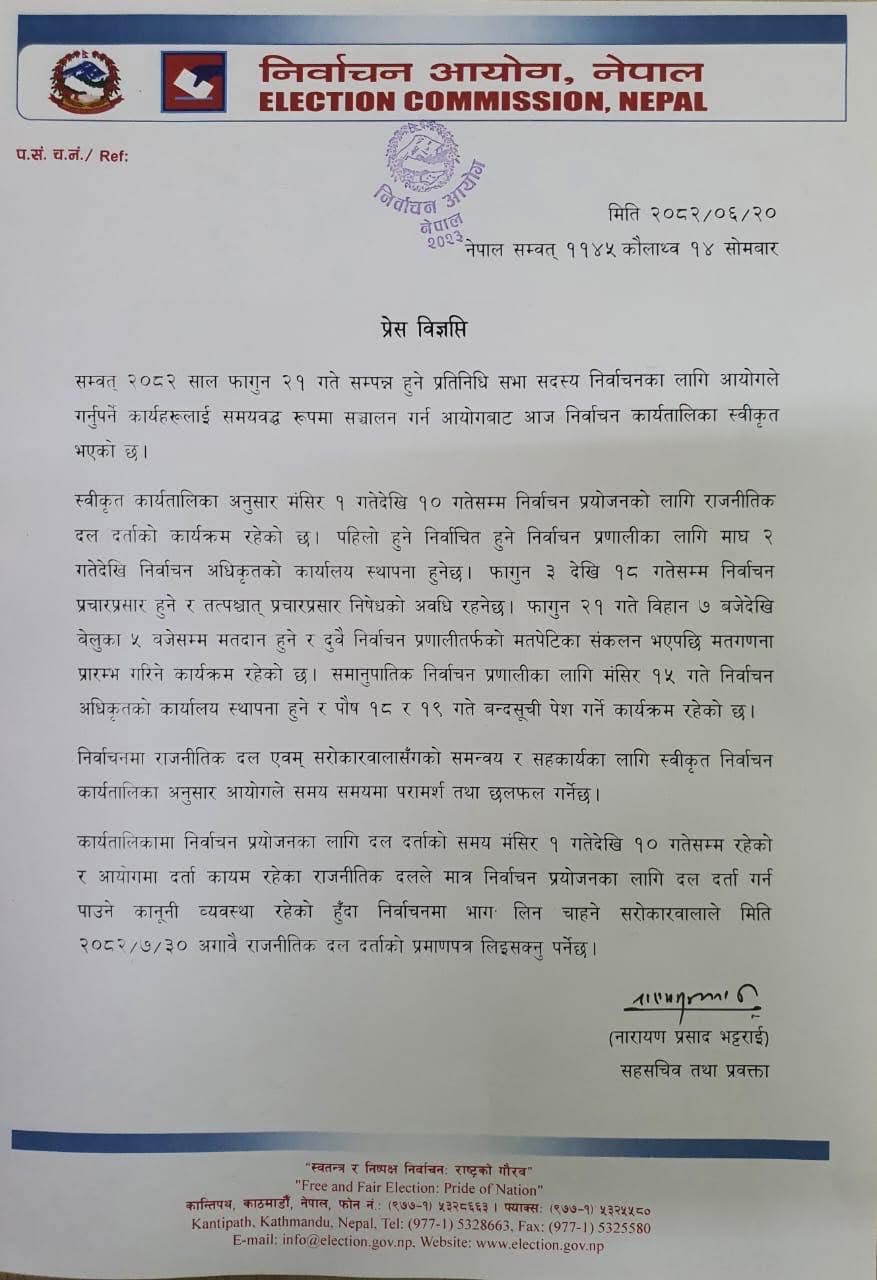
Kathmandu – Nepal is set to hold its House of Representatives (HoR) election on March 5, 2026, following a period of unprecedented political upheaval driven by youth-led protests on September 8 and 9. The Election Commission (EC) has officially finalized the electoral calendar, detailing the registration of political parties, candidate nominations, campaign periods, and voting procedures in preparation for the snap polls.
The recent Gen Z uprising, characterized by widespread demonstrations and organized rallies across major cities, has emerged as a defining moment in Nepal’s political landscape. Young voters, mobilized by demands for government accountability, transparency, and systemic reform, played a crucial role in reshaping political priorities. The movement led to the dissolution of the House of Representatives on September 13, as announced by President Ram Chandra Paudel on the recommendation of the interim government led by Prime Minister Sushila Karki. This paved the way for mid-term elections just five months away, signaling a generational shift in Nepalese politics.
Election Schedule and Procedures
According to the EC, political parties intending to contest the elections must be officially registered by November 16, 2025, and complete the election registration process between November 17 and 26. The registration process requires submission of party statutes, flags, election symbols, and signatures from at least 500 voters. The EC has emphasized that only parties meeting these deadlines will be eligible to participate in the polls.
The electoral offices for the first-past-the-post (FPTP) system will be established starting January 16, 2026, while offices for the proportional representation (PR) system will open earlier, from December 1. Parties contesting the PR seats are required to submit their closed lists of candidates on January 2 and 3, with the campaign period running from February 15 to March 2. Following the campaign, a two-day silence period will be observed before nationwide voting from 7 a.m. to 5 p.m. on March 5. The counting of ballots from both FPTP and PR systems will begin immediately after the polls close.
The HoR will comprise 275 members, with 165 elected under FPTP and 110 through proportional representation based on party vote shares. The EC has reported that as of mid-April 2025, 18,148,654 voters were registered for the upcoming polls, reflecting an increase of over 160,000 voters since the November 2022 election.
Youth Influence and Political Realignments
The Gen Z-led protests have not only accelerated the election timeline but also encouraged the formation of new political parties aimed at representing younger generations. Notably, Dharan Sub-Metropolitan Mayor Harka Sampang has already applied to register the Shram Sanskriti Party, with Harka Bahadur Rai serving as coordinator. Kathmandu Metropolitan City Mayor Balen Shah, another prominent figure in the youth movement, has yet to announce plans for a new party but remains an influential voice in national politics.
Several youth groups that participated in the September 8–9 demonstrations are reportedly in consultations to establish political platforms to contest the March elections. Analysts note that this surge of youth-driven political participation could redefine traditional party structures and campaign strategies, placing generational concerns such as employment, education, and social justice at the forefront.
Preparations and Security Measures
The EC has outlined a series of preparatory measures to ensure a free, fair, and transparent election. Acting Chief Election Commissioner Ram Prasad Bhandari stated that the commission is currently finalizing logistics, including security arrangements, office infrastructure, and budgeting. Historically, a significant portion of election funds is allocated to security, with both existing police forces and temporary personnel deployed to maintain order during the campaign and polling periods. The commission has pledged austerity in its spending while ensuring that resources are adequate to conduct the elections smoothly.
Regular consultations between the EC, political parties, and stakeholders are planned to facilitate coordination and address emerging challenges. The commission emphasized that adherence to deadlines and procedural requirements is critical for maintaining the integrity of the election process.
As Nepal approaches the March 2026 elections, the spotlight remains on the role of youth in shaping the country’s political future. The Gen Z protests of September 8 and 9 have highlighted widespread public dissatisfaction with traditional governance structures, underscoring the demand for more accountable and responsive leadership. With new parties emerging, established political entities recalibrating strategies, and the EC implementing a structured electoral framework, the upcoming polls are widely seen as a turning point in Nepalese democracy, where the voices of the younger generation could decisively influence the nation’s trajectory.